Thursday, June 24, 2010

Leftist Letters to the Editor

Against all odds, the Free Press decided to print my most recent letter to the editor. View the letter itself here: Who do they work for? It appears that if your letter is short enough, they'll print just about anything!

Writing to the editor is intellectually stimulating, ego-gratifying and (word that means a release of pent-up negative emotion that I can't remember right now). It's a low-risk, low-effort hobby that all good leftist should engage in. So, in order to encourage other politically-minded bleeding-heart pinkos to send in their own letters, I decided to create a facebook page. I called it Leftist Letters to the Editor. If you join, you can use the page to post letters that you submitted but never got printed, post letters you did get printed, see the letters of others, and recieve semi-regular suggestions in your news feed of articles worthy (in my humble estimation) of response (either praise or derision).

Edit: cathartic

Tuesday, June 1, 2010

The letter to the editor that the Free Press did print

Jac wrote an insightful letter to the Free Press that actually got published. Unfortunately, they gave it a completely unrepresentative title which means that the editors interpreted it to mean almost the complete opposite of what was intended. I can find no fault with the flawlessly precise writing and therefore must conclude that the editors are nincompoops. Link to the edited version here.

Below is the original text:
Friday's Free Press would be excellent fodder for any course in media literacy, as it contains examples of both refreshingly enlightened and disappointingly irresponsible journalism as writers respond to the recent spate of violence in the West End.

In his article, “Con out early; girl, 6, violated,” Mike McIntyre appears bent on making the point that Judge Ray Wyant's decision to sentence a non-violent property offender to only six months in jail directly led to the sexual assault of a six-year-old girl. McIntyre reminds the reader that Greg Glen Hope “would likely have been in jail at the time of the attack had the Crown got their way,” and laments that Hope's early release “allegedly pav[ed] the way for Sunday night's attack on the child.” Considering that the charges in question were one break and enter and a string of probation breaches, what would McIntyre have had Judge Wyant do? Assume that all property offenders or individuals who breach their probation are potential child predators and err on the side of caution by handing them the maximum sentence possible? This type of editorializing plays well with a scared and angry public, but it adds nothing to a productive discussion about how to make our neighbourhoods safer.

Dan Lett, on the other hand, takes a level-headed approach in his editorial “Deal with crime wave's root causes,” pointing out that more police and more helicopters are mock solutions designed to create an illusion of safety and exploit public ignorance about the causes of crime. The solutions we really need are not so simple – or popular – and it takes a brave journalist to call for them at a time when fear and anger are running high.

Tragedies such as those in West End bring the problem of crime and violence in impoverished neighbourhoods into the public eye and mobilize citizens to action. Such action can take one of two forms: we can look closely at the causes of crime in the inner-city and come together to lobby for the complex, compassionate and sensible solutions that such crime necessitates; or we can roll out the same tired old harsher-sentences, let's-get-tough rhetoric that not only doesn't work in fighting crime, but also creates more pain and more tragedy.

The media is critical in helping to determine which of these paths a community will take. Thoughtful responses such as Lett's help to facilitate the first approach. Articles such as McIntyre's only add fuel to the already tremendously destructive fire of the latter.

Friday, May 28, 2010

The Great GMO Blog Debate

The following is a continuation of the debate between myself and a fellow blogger. You can read the beginnings of the debate here, watch the video that was responded to here, read the transcript of that video here and view the website of the man speaking in the video here.


In retrospect, I should not have just posted a video link without actually giving my perspective on the matter and saying which specific arguments in the video convinced me. I should have also specified that my problems with GE organisms were largely outside the scope of the scientific issues you tackled in your original post. Finally, I should have re-viewed the video before posting it because I hadn't seen it in a few months and didn't recall the exact content. Hopefully this response will clear things up.

Allow me to summarize your first post: “all natural” and “organic” are scientifically meaningless, genetic engineering is more efficient than artificial selection; genetic engineering results in lower production costs, fewer pest problems, reduced use of pesticides, and better yields; we need to be vigilant about the over-use of certain pesticides; overall, GE crops are good for people and the planet. I agree with every single point you make except for the conclusion that you reach (good for people and planet). How is it possible that we agree on all these facts and yet reach different conclusions? The answer is that you left out some very important questions about implementation in your analysis.

Unsurprisingly, the same types of greedy corporations that build showers that electrocute soldiers in Iraq and drill for oil without adequate safety measures or contingency plans also do shady things with GE crops that don't show up in scientific studies about crop production and profitability.

For starters, some GE companies sell “terminator seeds”. These seeds only produce one generation of plants because the seeds produced by the first generation are sterile. This is very harmful for impoverished farmers in the third world because they rely on saving seeds from the previous year's crop. Terminator seeds force them to return to agriculture companies year after year in order to buy new seeds. The companies' goal is not to feed the world more efficiently; they are only motivated by profit.

GE crops are patented and many can only be sprayed with patented pesticides that are produced by the same companies that make the seeds. This has resulted in a reduction of competition between pesticide manufacturers which means that the price of pesticide goes up and farming becomes a less viable way to make a living.

Another problem with the patenting of life that occurs with GE crops is that it results in multinational corporations enforcing their patents by suing farmers. Through no fault of their own, these farmers have their crops contaminated by airborne seeds or pollen from neighbouring fields. A famous case of this sort occurred in Canada to a man named Percy Schmeiser. Even though Mr. Schmeiser won his case in the end, he still had to endure a lengthy and expensive legal battle. Other farmers have not been lucky enough to have the resources to wage legal warfare with the army of lawyers employed by the biotech industry.

When one company's GE crop dominates a region then there is a drastic loss of genetic diversity. Genetic diversity is an important safe-guard against catastrophic crop failure due to disease, fungus or pests. Crop failure on a large enough scale could result in millions of deaths due to starvation.

GE crops have approximately the same nutritional value as conventional crops. Unfortunately, selective breeding in conventional crops is guilty of causing our food to be less nutritious than it once was. For the entire history of agriculture, plants have been bred for their resistance to environmental factors, quick growth, pleasing appearances and ease of transportation. The most important thing that genetic engineers should be worried about is making sure that the food we eat is more nutritious; not just heartier, bigger and more attractive.

I emphatically agree with you when you say, in summarizing the original post, that “science isn't the enemy.” You've outlined several arguments that demonstrate that there are clear advantages to using GE foods and that the labels 'all natural' and 'organic' rely on consumer ignorance of the naturalistic fallacy. However, while science isn't the enemy, it also isn't the panacea that some make it out to be. Science needs to be reigned in by sound legislation and rigorous regulation in order to protect the environment and future generations of humanity. Despite the fact that his rhetoric is a little over the top and many of his facts related to the science of GE crops are questionable at best, Mr. Smith's recommendations to only grow GE crops indoors and to end the practice of patenting life seem quite reasonable to me. He encourages us to be vigilant of both the scientific and economic dangers involved with GE crops. What better ways could there be to assure cautious progress?

P.S. Spider-goat FTW!

Friday, May 21, 2010

The letter to the editor that the Free Press wouldn't print

In response to this article I wrote this letter to the editor:

Re: Province to give tax credits for fertility treatments (May 18)

According to Paula Chorney of the Infertility Awareness Association of Canada , "Infertility is a life-stresser that is all-consuming." Is that sort of like the stress that comes with trying to feed a family of four while on welfare?

Instead of subsidizing the birth of more children to the tune of $800,000 per year, our tax dollars should go towards helping children who have already been born – for instance, those living in rural First Nations communities who don't even have access to fundamental essentials such as clean drinking water.

Infertile individuals who desperately want children should consider adoption. I understand that the adoption process is far from easy and the system is far from perfect. Yet, wouldn't it make more sense to spend $800,000 annually on improving the flawed system and making the adoption process less painful?

The government should not be in the business of helping families “do exactly what they've always dreamed of doing.” It should be focused on meeting the basic needs of its citizens. Once it has begun to do an adequate job of that, perhaps we can discuss the subsidization of expensive treatments that allow more rich old white women to get knocked-up.

Thursday, May 20, 2010

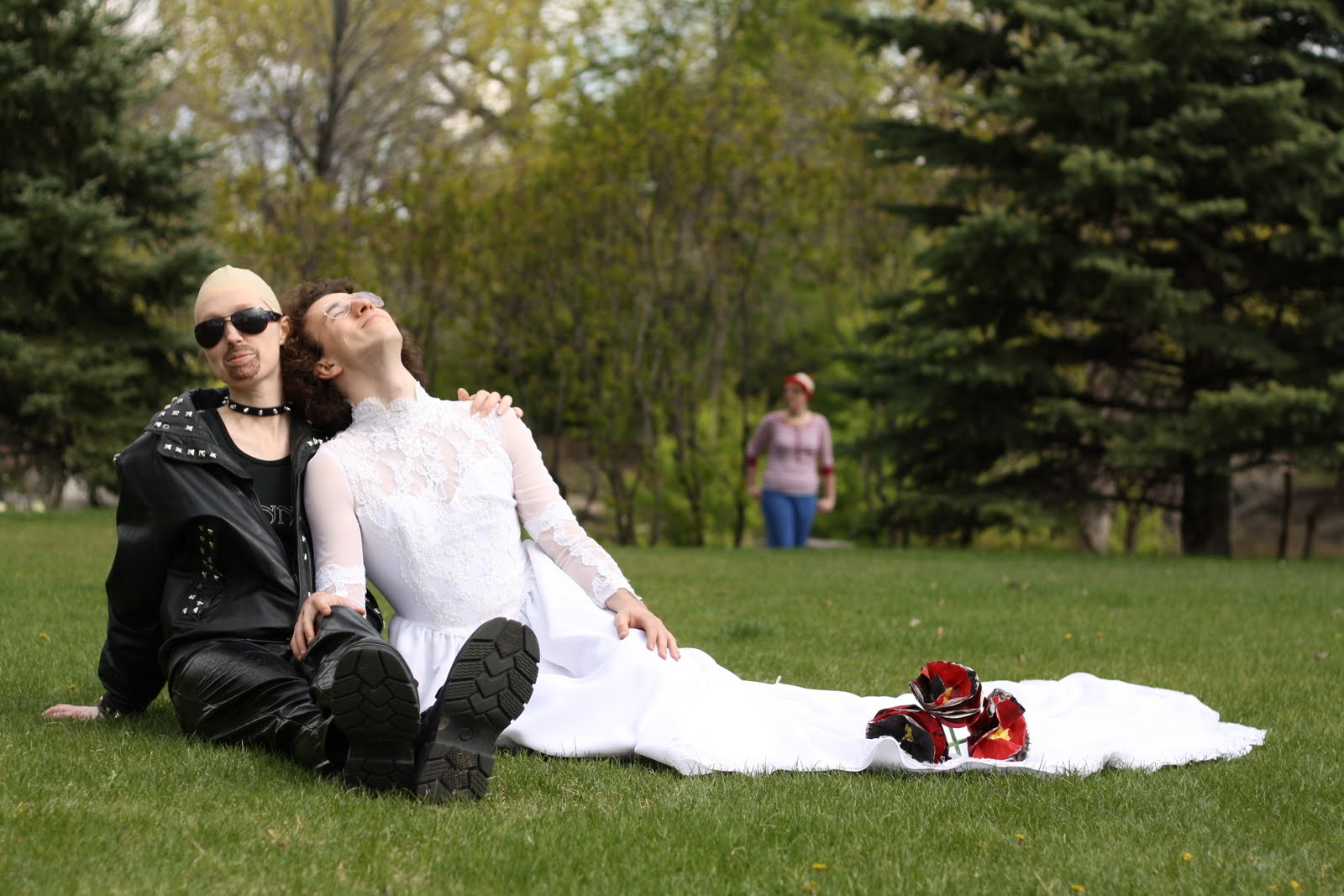
My Anti-Wedding Transcript

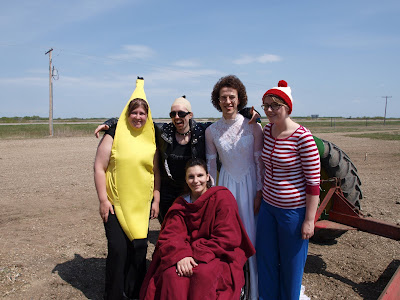
Jennifer (wearing a Snuggie):

Dearly beloved, we are gathered here today to join together in matrimony this man and this woman, united in their opposition to political and economic systems of repression and hierarchy; their dedication to class treason and civil disobedience; and their appreciation of the importance of good dental hygiene.

Theirs is a union founded upon a commitment to activism, anti-patriarchy, and the destruction of church and state. They share a kindred passion for egalitarianism, a disgust for heedless consumption, and a reluctance to further burden our already fragile ecosystem through reckless procreation. Today we celebrate their hopes, dreams and aspirations as they unite in a marriage of pragmatism and convenience, of possible monetary benefit, and of admitted probable impermanence.

Let us open this ceremony by inviting Amanda, the maid of honour, to come forward and read a passage that means a great deal to the happy couple. Amanda will be reading an excerpt from Emma Goldman's writings on love and marriage, found in her 1917 “Anarchism and Other Essays.”

Amanda (as a giant banana):

Free love? As if love is anything but free! Man has bought brains, but all the millions in the world have failed to buy love. Man has subdued bodies, but all the power on earth has been unable to subdue love. Man has conquered whole nations, but all his armies could not conquer love. Man has chained and fettered the spirit, but he has been utterly helpless before love. High on a throne, with all the splendour and pomp his gold can command, man is yet poor and desolate, if love passes him by. And if it stays, the poorest hovel is radiant with warmth, with life and colour. Thus love has the magic power to make of a beggar a king. Yes, love is free; it can dwell in no other atmosphere. In freedom it gives itself unreservedly, abundantly, completely. All the laws on the statutes, all the courts in the universe, cannot tear it from the soil, once love has taken root. If, however, the soil is sterile, how can marriage make it bear fruit? It is like the last desperate struggle of fleeting life against death.

Love, the strongest and deepest element in all life, the harbinger of hope, of joy, of ecstasy; love, the defier of all laws, of all conventions; love, the freest, the most powerful moulder of human destiny; how can such an all-compelling force be synonymous with that poor little State and Church-begotten weed, marriage?
Jennifer:

Thank you, Amanda. And now I'd like to call forward the best man, Kelsey, who will be reading a passage from Deuteronomy, chapter 22, verses 13-30.

Kelsey (as Waldo):

Suppose a man marries a young woman, and later decides he doesn't want her. So he makes up false charges against her, accusing her of not being a virgin when they got married. If this happens, the young woman's parents are to take the bloodstained wedding sheet that proves she was a virgin, and they are to show it in court to the town leaders. Her father will say to them, “I gave my daughter to this man in marriage, and now he doesn't want her. He has made false charges against her, saying that she was not a virgin when he married her. But here is the proof that my daughter was a virgin; look at the bloodstains on this wedding sheet!” Then the town leaders are to take the husband and beat him. They are also to fine him a hundred pieces of silver and give the money to the young woman's father, because the man has brought disgrace on an Israelite woman. Moreover, she will continue to be his wife, and he can never divorce her for as long as he lives.

But if the charge is true and there is no proof that she was a virgin, then they are to take her out to the entrance of her father's house, where the men of the city are to stone her to death. She has done a shameful thing among our people by having intercourse before she was married, while she was still living in her father's house. In this way, you will get rid of this evil.

If a man is caught having intercourse with another man's wife, both of them are to be put to death. In this way, you will get rid of this evil.

Suppose a man is caught in a town having intercourse with a young woman who is engaged to someone else. You are to take them outside the town and stone them to death. She is to die because she did not cry out for help, although she was in a town, where she could have been heard. And the man is to die because he had intercourse with someone who was engaged. In this way you will get rid of this evil.

Suppose a young man out in the countryside rapes a young woman who is engaged to someone else. Then only the man is to be put to death; nothing is to be done to the woman, because she has not committed a sin worthy of death. This case is the same as when one man attacks another man and murders him. The man raped the engaged woman in the countryside, and although she cried for help, there was no one to help her.

Suppose a man is caught raping a young woman who is not engaged. He is to pay her father the bride price of fifty pieces of silver, and she is to become his wife, because he forced her to have intercourse with him. He can never divorce her as long as he lives.

No man is to disgrace his father by having intercourse with any of his father's wives.

Jennifer:

Thank you, Kelsey. (To Jacquie and Rob) May those words from the Good Book provide you with comfort, direction and guidance as you embark on your life's journey together.

(To the camera/congregation) And now, the couple will read vows that they themselves have prepared. (Rob passes his bouquet to Kelsey)


Jacquie (as Rob Halford):

I, Jacquie, take you, Rob, to be my lawfully wedded husband, to have, to hold and to financially support from this day forward, for better or for worse, for richer or for poorer, in sickness and in health, until such a time as our political paradigms become incompatible and we amicably part, resolving to remain friends and to set each other up with other fellow radicals who could help us continue The Plan.

I promise to share with you my joy and my sorrows, my successes and failures, and also my access to health and dental benefits, including but not limited to 70% of eligible prescription drugs, 70% of paramedical services such as massage therapy and naturopathy, 100% of contact lens or eyeglass expenses up to a maximum of $125/year, and basic insurance coverage for accidental death or dismemberment.

I promise to love you, comfort you, and keep you, for as long as we both find the relationship sufficiently fulfilling to justify its continued existence. This is my solemn vow

Rob (wearing a white lace wedding dress):

I Robert, ask you, Jacquie, to be my lawfully wedded wife. I promise to give according to my abilities and take only according to my needs. I promise to be your equal partner and respect and nurture you without infringing upon your sense of personal identity. I promise that I will respect your agency and never demand any form of obedience from you. I promise to stay married to you for as long as our partnership continues to be mutually beneficial. I promise to save the world, bit by bit, every day, according to the tenets of The Plan. Finally, I promise to utilize a multi-systems analysis that encompasses radical perspectives on gender, sexuality, race and class when debating and theorizing about issues of pronounced political import. This is my solemn vow.

Jennifer:

(To Amanda) May I have the rings, please?

In keeping with the declarations you have made, you give and you receive these rings. Jacquie, will you place this ring on Rob's finger and repeat after me: With this ring, I thee wed.

Jacquie: With this ring, I thee wed.

Rob, will you place this ring onto Jacquie's finger and repeat after me: With this ring, I thee wed.

Rob: With this ring, I thee wed.

I now call upon the wedding couple and their witnesses to make this legal as we sign the marriage registry. As we do so, Kelsey will serenade us with a song of great significance to the bride and groom, originally composed by the self-appointed gods of metal, Judas Priest.

(Jacquie and Rob sign the registry, followed by Amanda. Amanda takes the registry and pen over to Kelsey, who then signs it, and resumes playing “Breaking the Law”.)

Thank you, Kelsey. Jacquie and Rob, having witnessed your vows for each other with all who have assembled here, I now solemnize this marriage: by the power vested in me, however unwisely, by the Province of Manitoba, I now pronounce you husband and wife. You may kiss the bride.